Hey everyone, let’s cut to the chase—if you’ve ever shopped for machine work lights (full transparency, that’s what my team and I supply every day), you’ve probably stared at a spec sheet and thought, “Wait, is this light actually bright enough for my mill? Or is this marketing fluff?” I’ve lost count of how many times a customer has called us like, “My old light says 10,000 lumens but it can’t illuminate the end of my lathe—what gives?” Today I’m breaking down exactly how machine work light brightness is actually measured, no jargon, no fancy corporate spin, just real talk from someone who deals with this stuff 8 hours a day. Machine Work Light
First off, let’s kill the biggest myth: lumens aren’t the end-all-be-all. I know, I know—everyone throws lumens around like they’re the only number that matters. But here’s the thing: lumens measure total visible light the light puts out in all directions, right? For a machine work light, you don’t want light bouncing off the ceiling or the walls—you want it focused on your workpiece, your tool, the stuff you’re working on. That’s where things start to get specific to industrial lighting, not just the bulb in your fridge.
Let’s start with the real core measurement here: illuminance, not lumens. Illuminance is how much light hits a specific area—that’s the number you actually care about for a machine shop. It’s measured in lux (or sometimes foot-candles, if you’re old-school). Wait, quick side note: 1 foot-candle is roughly 10 lux, so that’s easy math for when you’re comparing old specs vs new. For machine work, the sweet spot is usually 500 to 1000 lux at the workpiece, depending on the task. If you’re doing precision work—like tapping tiny holes on a CNC mill, or checking for surface scratches on a part—you’re gonna want closer to 1000 lux. If you’re just doing rough deburring, maybe 500 is enough, but don’t skimp there—bad lighting leads to mistakes, lost parts, even safety issues.
Now, why do lumens lie so often for machine lights? Let’s say you have two lights: both 10,000 lumens. One is a basic strip light that spreads light all over the ceiling, so when you hold a light meter 1 foot above your workpiece, it only reads 200 lux. The other is a focused LED work light with a narrow beam angle, so all those 10,000 lumens are pointed directly at your tool path, giving you 1200 lux. Same lumen number, totally different real-world performance. That’s why as a supplier, we never lead with lumens on our product pages—we lead with measured lux at a standard distance, usually 12 inches or 24 inches, because that’s how close the light is to the workpiece on most machines.
Wait, but there’s more to it than just lux. We also look at color temperature and CRI, and yeah, those tie into how “bright” the light feels even if the numbers are the same. Color temperature is measured in Kelvin (K). If your light is too warm—like 2700K, that’s the yellow light in your living room—it’ll make it hard to see fine details, especially metal parts. Machine work lights should be 5000K to 6500K—that’s the bright, neutral white light that matches natural daylight, so colors and edges pop. Then there’s CRI, or Color Rendering Index. That’s a score from 0 to 100 that tells you how accurately the light shows colors. A CRI of 80 is okay for rough work, but for precision stuff, we recommend CRI 90 or higher. Why does that matter? If you’re checking if a stainless steel part has a tiny scratch, and your light is bad at rendering silver tones, you’ll miss that scratch, which leads to bad parts getting shipped. I’ve had customers tell us they switched to our lights just because they could finally see those micro-scratches they’d been missing for months—you don’t get that from just high lumens.
Another big one for machine work lights: beam angle. This is measured in degrees, and it’s how wide the light’s focus is. For small, handheld tools or CNC machines with tight work envelopes, a narrow beam angle—like 15 to 30 degrees—gives you a tight, intense spot right where you need it, no waste. For larger machines, like big lathes or vertical mills, a wider beam angle (45 to 60 degrees) lights up a bigger area without getting dim at the edges. Cheap lights sometimes have a super wide beam, so the center is bright but the edges are garbage—you end up with a dim spot where your tool is moving. We test every single one of our lights for beam uniformity, so the entire workpiece area gets consistent brightness, not just a hot spot in the middle.
Wait, let’s talk about real-world testing, because lab numbers don’t always translate. As a supplier, we don’t just plug numbers into a spreadsheet—we test every model in actual machine shop settings. We mount our lights to a Haas mill, a Bridgeport lathe, even a laser cutter, and use a professional light meter to measure lux at the exact height and angle the light will be used. That’s how we make sure our spec sheet says “1000 lux at 12 inches” and that’s exactly what you get when you install it. A lot of competitors just use lab tests where they measure lux at a perfect 90-degree angle, no obstructions, but in real life, your light is next to a metal guard, maybe cutting fluid is splashing on it, so the angle is a little off. We account for that.
Oh, and let’s not forget about brightness over time—maintained lumens or maintained lux. LEDs don’t burn out all at once, they dim slowly. A lot of lights will say “10,000 lumens new” but after 10,000 hours, they’re at 7,000 lumens. We rate our lights at their maintained brightness at 50,000 hours, which is the standard lifespan for industrial LEDs. So you’re not buying a light that’s super bright for the first month, then useless a year later. I’ve had customers tell us their first light from a big box store lasted 6 months and was already dim—we hear that all the time, because they skipped the industrial grade.
Let me give you a quick example to make this concrete. Last quarter, a customer from a local aerospace shop called us panicking. They had 12 old machine lights that were supposed to be 8,000 lumens, but their CNC operators were missing tiny rivet holes on aluminum parts, leading to reworks. We sent them our medium-beam work lights, which are rated at 1100 lux at 12 inches, CRI 92, 5500K. They called back a week later saying their rework rate dropped 40%. Why? Because those old lights were wide-beam, only hitting 350 lux at the tool center, and they had a bad CRI that made silver aluminum look flat. It wasn’t the lumen number—it was how the light actually performed on their machine.
So to wrap this up, the actual things you should look for when judging machine work light brightness (not just marketing numbers) are:
- Measured illuminance (lux) at your machine’s standard distance (not a random lab number)
- Color temperature (5000K-6500K for work, no warm yellow junk)
- CRI (80 minimum, 90+ for precision work)
- Beam angle matched to your machine’s size
- Maintained brightness over the light’s lifespan (not just new-out-of-the-box numbers)
If you’re still confused about what’s right for your shop, or you’re tired of dealing with lights that don’t deliver what they promise, my team and I are here to help. We don’t do one-size-fits-all—we’ll talk through your machines, the tasks you do, and what you actually need to get the job done right. No sales pitches, no confusing jargon, just straight answers. Hit us up anytime to chat through your lighting needs—we’re in this industry too, so we get the grind.
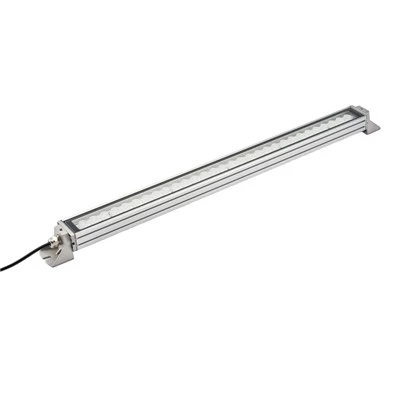
When you’re shopping for machine work lights, don’t get bamboozled by flashy lumen numbers. Focus on real, usable brightness that solves your actual work problems. That’s what we build, and that’s what we stand behind.
Usb Stack Light References:
Illuminating Engineering Society (IES) Lighting Handbook, 10th Edition
American National Standards Institute (ANSI) C78.377-2017: American National Standard for Electric Lamps – Specifications for the Chromaticity of Solid State Lighting (SSL) Products
National Institute of Standards and Technology (NIST) Light Measurement Guidelines for Industrial Workspace Lighting
Suzhou Pouge Lighting Electrical Appliance Co., Ltd.
As one of the most professional machine work light manufacturers and suppliers in China, we also support customized service. Please feel free to wholesale advanced machine work light made in China here and get quotation from our factory. For price consultation, contact us.
Address: Building 6-501, No.1330, Jinfeng South Road, Mudu Town, Wuzhong District, Suzhou City, China
E-mail: xduanlyy@126.com
WebSite: https://www.pouge-light.com/
